




By Jules Rhee, MEd | Latest update 3/2/2026
Tired of students grabbing the first number they see? Learn how to teach the CUBES math strategy for word problems – step by step. Includes tips for multi-step problems, keyword traps, and why drawing is actually a power move. Classroom-tested for grades 3-4.
Word problems aren’t hard because of the math.
They’re hard because students have to juggle reading + reasoning + deciding what matters + choosing an operation… all at the same time.

And in 3rd–4th grade, word problems start leveling up fast – multi-step, extra information, tricky wording, and questions that don’t say, “Hey! Use subtraction!” (We wish.)
That’s why I like the CUBES strategy. It gives students a consistent, step-by-step routine that helps them slow down and make sense of the problem before they ever start calculating.
Why word problems trip up upper elementary kids
Word problems are a staple for a reason – they connect math to real life. Some are a little silly (why does anyone need 60 watermelons??), but the skill is important.
Here’s what I saw with 3rd – 4th graders:
- They rush and grab the first number they see
- They don’t fully understand what the question is asking
- They mix up part vs. total
- They get thrown off by extra information
- They do one step and think they’re done
So instead of telling them “read carefully” (which… they’ve heard 9 million times), CUBES gives them something more helpful:
⮕ a routine they can follow every time
What is CUBES?
CUBES is a word problem strategy that helps students organize information and stay focused.
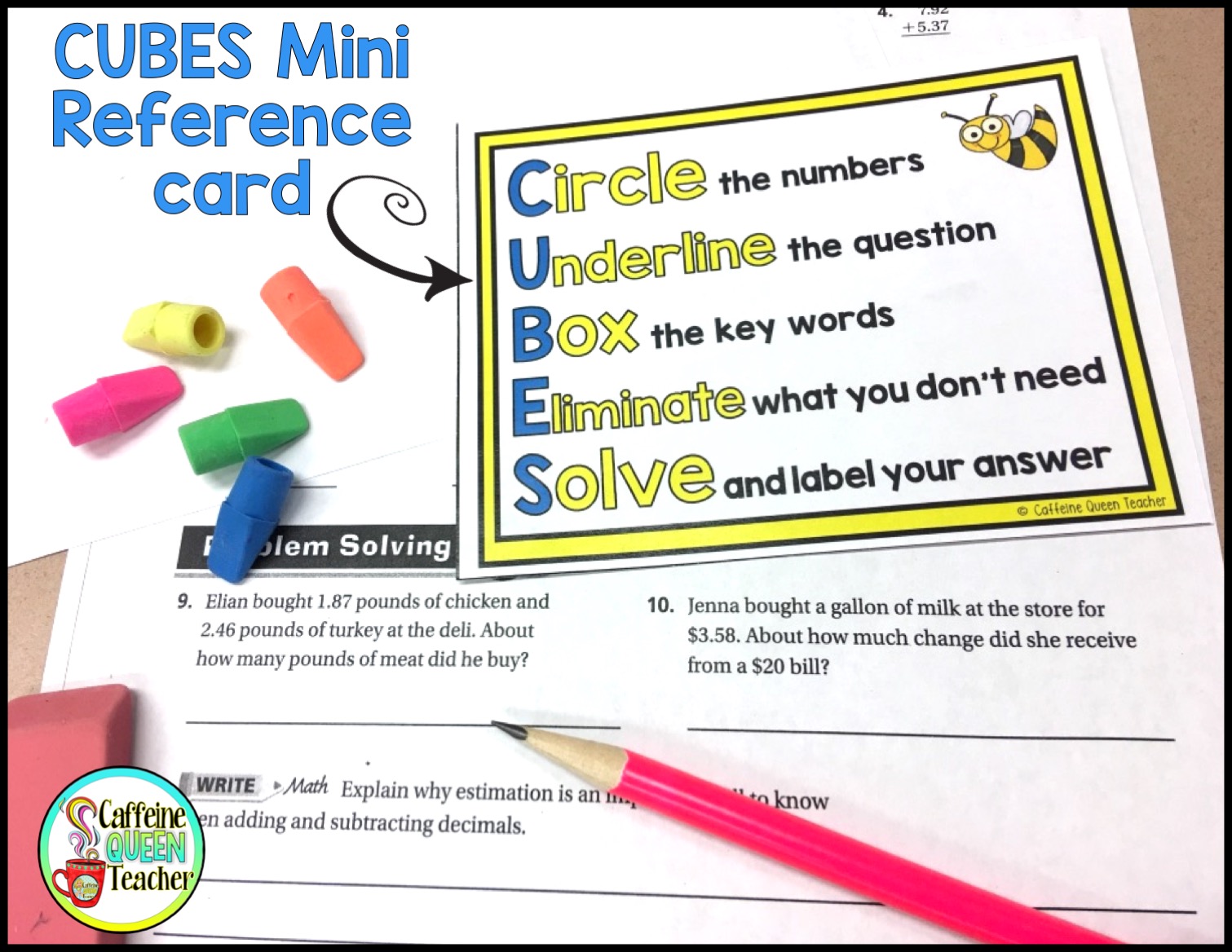
C – Circle the numbers
U – Underline the question
B – Box the keywords (careful – more on that below)
E – Eliminate extra information
S – Solve and check
Some teachers also add a D = Draw (CUBED), which is fantastic for 3rd–4th grade because drawing helps students represent the situation and catch mistakes.
How I taught it (whole group + small group)
I introduced CUBES to the whole class first… but I kept a close eye on my strugglers.
Then I pulled a small group to reteach it with just a few problems at a time.
My personal rule:
The bigger the struggle, the smaller the group.
And I’d rather have students complete 3 problems correctly using the strategy than rush through 10 problems incorrectly.
Step-by-step: CUBES (upper elementary version)
Step 1: Read it like a detective (twice)
Before pencils move, students read the problem twice.
Then I ask:
- “What is happening in this situation?”
- “What do we know so far?”
- “What are we trying to figure out?”
Here’s the key: they have to say it out loud (or to a partner).
If they can’t explain it, they don’t understand it yet – and solving won’t go well.
Teacher tip: If needed, break it down sentence-by-sentence and give think time. The discussion takes time… but it saves time later because you’re not reteaching the whole page after everyone bombs it.
Step 2: Circle numbers AND labels
In 3rd–4th grade, I don’t just circle numbers. I circle numbers with labels.
So not just “12”… but “12 tickets” or “12 minutes” or “12 pages.”
Because unlabeled numbers = guessing.
And circling labels now means the final answer label is easier later.
Step 3: Underline the question (and rephrase it)
Students underline the question, then rewrite it in kid language:
- “So I’m trying to find ___.”
- “The question wants the ___.”
This is the moment where we do the part vs. total check:
- “Do we have a total and need parts?”
- “Do we have parts and need a total?”
- “Do we have a compare situation?”
If students aren’t clear on what they’re solving for, they can’t choose the right operation.
Step 4: Box keywords (but don’t trust keywords)
This is where we level up the “keyword” conversation for upper elementary.
Because keywords are helpful… and also sometimes a trap.
Example: “more” can mean add OR it can mean compare.
“left” can mean subtraction OR it can mean “on the left side of the shelf.”
So I teach it this way:
⮕ Box keywords, then prove it with the situation.
We use keywords as a clue, not as the answer.
Step 5: Eliminate extra information (lightly)
Students cross out extra info lightly with one line (so it’s still readable).
This step takes practice because some kids cross out everything… and some kids think every single detail matters.
A quick script that helps:
- “Does this information help me answer the question?”
- “Will I use it in a step?”
If not, cross it out.
Step 6: Draw or represent
For 3rd–4th graders, drawing is not “cute” – it’s strategy.
They can draw a quick sketch or represent the situation with:
- a picture
- a bar model
- tally marks
- a table
- an array
The goal here is clarity, not artwork.
Step 7: Decide if it’s multi-step
This is a big one in 3rd–4th grade.
If there’s more than one step, students label their steps:
- _____
- _____
And I remind them:
⮕ “If you solved something but you didn’t answer the question, you’re not done yet.”
Step 8: Solve and check
Now they solve.
Then they check:
- Does my answer make sense?
- Is it reasonable?
- Did I label it?
- Did I actually answer the question that was asked?
Make CUBES stick with simple routines
To help it become automatic, I like:
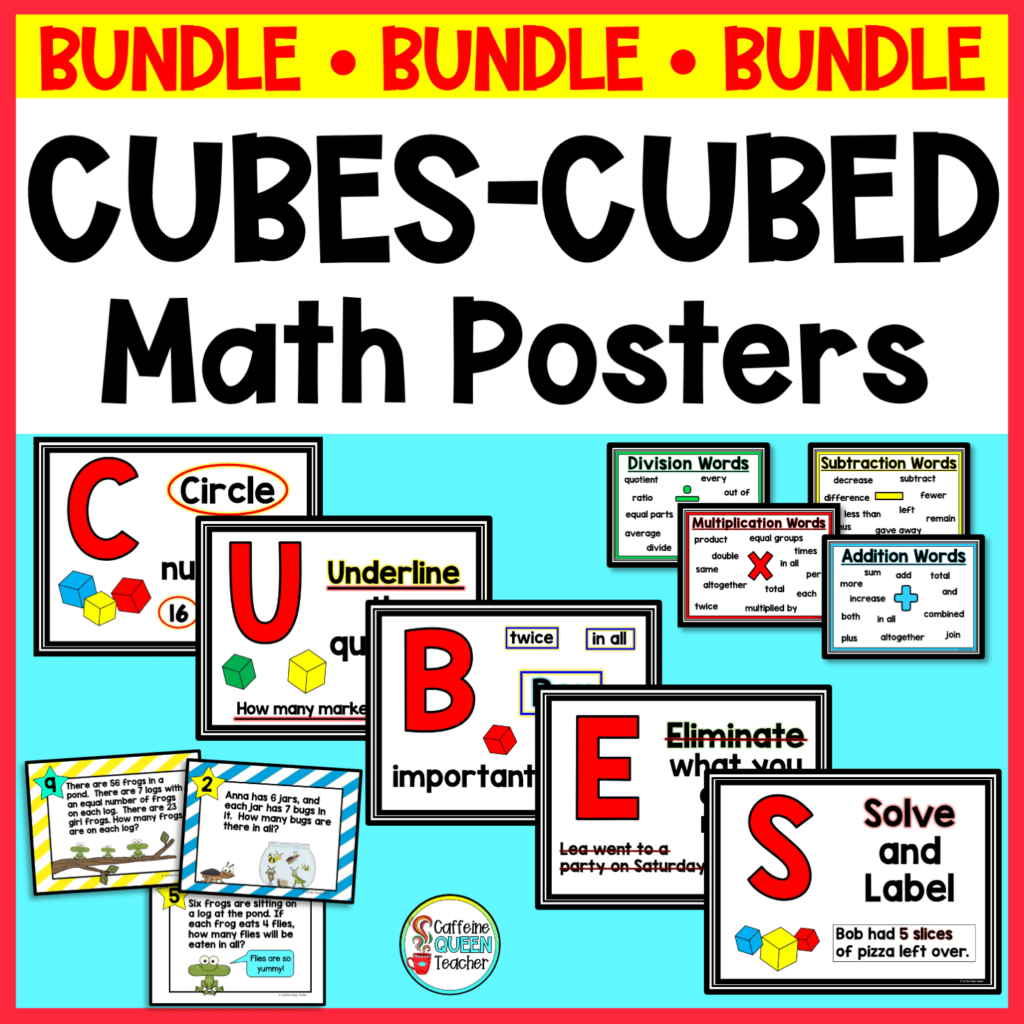
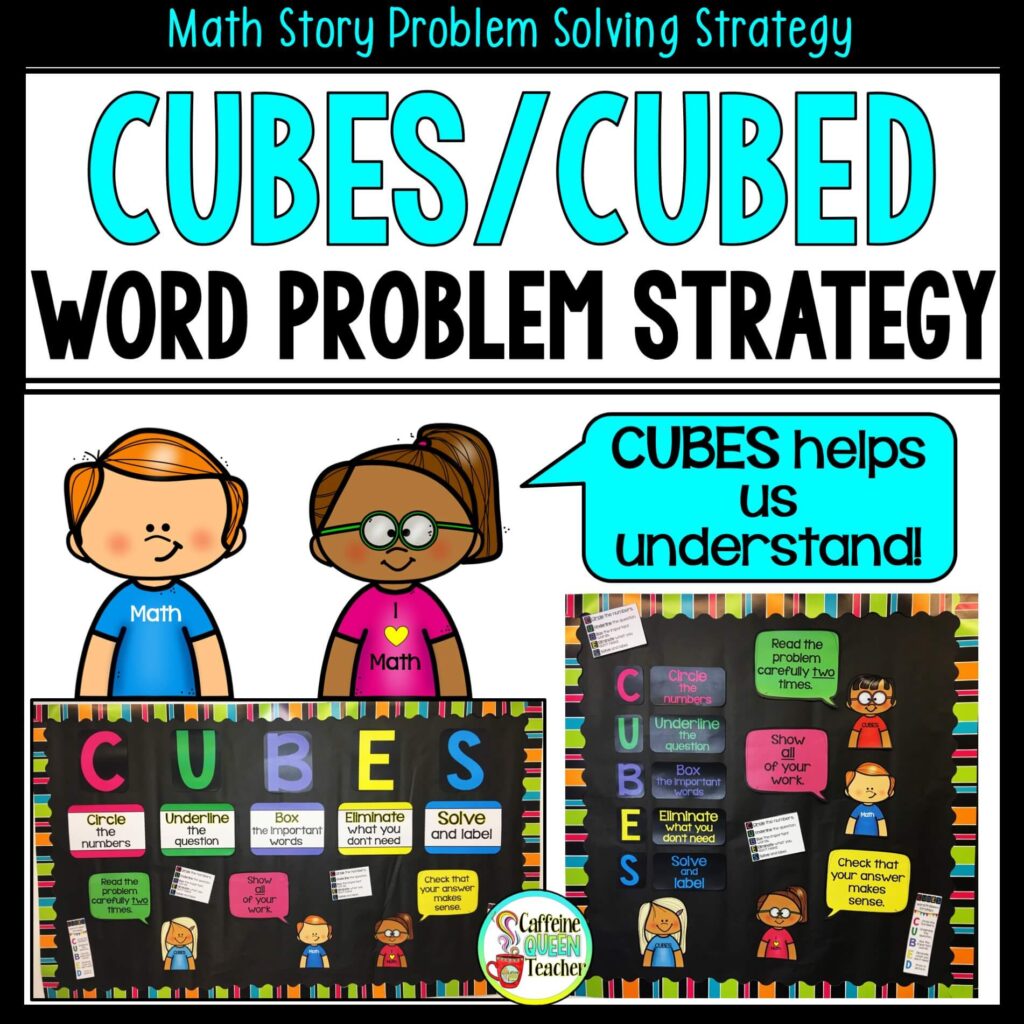
- a CUBES poster on the wall
- mini reference cards on desks
- consistent language during small group
Because when kids are overwhelmed, they don’t “remember strategies.”
They follow routines they’ve practiced.
Want more CUBES support?
If you want to go deeper, you can check out my other CUBES/CUBED post about math story problems and resources (posters, reference cards, and practice pages) that help students use the strategy independently.
Interested in additional CUBES Math Word Problem Strategy resources? Visit my Teachers Pay Teachers store for more options.
Maybe much of this is a simple review for you, but I hope that maybe there was a little idea that got you thinking a bit more deeply about word problems in your own classroom.
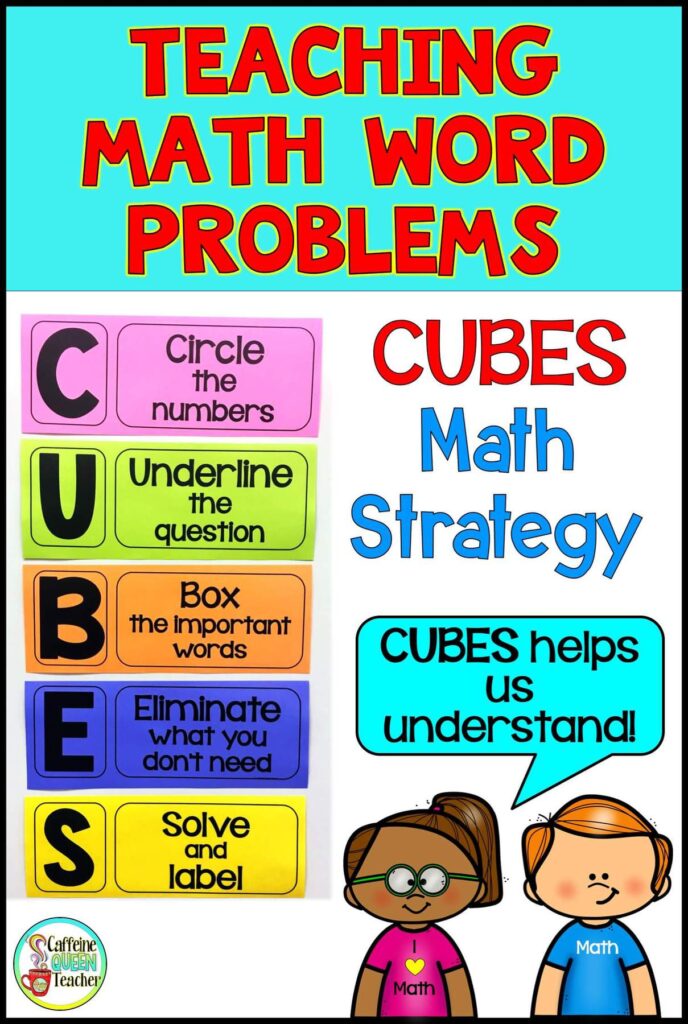
**There are plenty of strategies and sets out there similar to these posters. But, I love the CUBED (with the letter “D”) strategy best because of the emphasis on having students represent math problems with pictures or drawings (Drawings = D in the CUBED strategy).
And if you’re working on computation accuracy too, graph paper can be a sneaky helper for keeping work aligned and reducing errors – especially with multi-digit addition and subtraction.
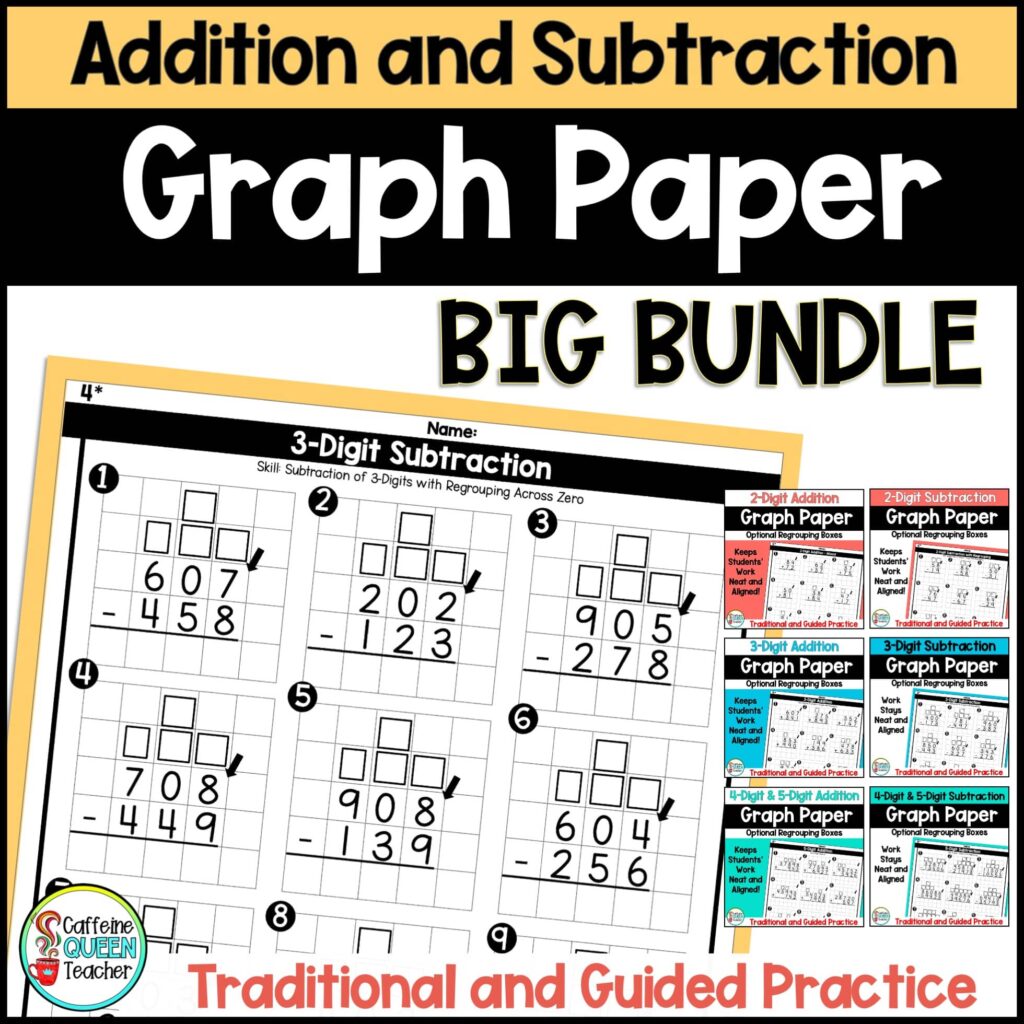
This proven method keeps students’ work neat and organized, which improves accuracy. These sets are a win-win for students and educators.
About the Author
Written by Jules Rhee, MEd., 30-year teaching veteran. Published 12/14/2014; Updated 3/2/2026.
Jules is the creator of Caffeine Queen Teacher (CQT) – Visual Math Organizers + Graph Paper Support. She’s a veteran teacher with over 30 years of classroom experience (SPED, upper elementary, and middle school) and a Master’s in Education (MEd). Jules shares practical, classroom-tested ideas and creates step-by-step resources that help students stay organized, confident, and successful – especially with multiplication and long division.
Read more about Jules here: About Page | Browse resources here: TpT Store