


By Jules Rhee, MEd | Latest update 3/2/2026
If you’re in Ohio and you’re driving to Texas… what direction are you traveling?

Sounds easy enough, right?
And yet… when you ask a group of kids, you’ll usually get a mix of confident guesses, confused faces, and one student who proudly announces “sideways.”
Here’s the thing: map skills don’t go away. They just keep stacking year after year. And if students don’t get a solid foundation early on, they stay confused – even when the maps get harder.
So let’s try it again:
Ohio → Texas. What direction?
If your students are like mine were, questions like this can feel weirdly tricky because the concept is too abstract. They mix up the starting point and ending point, or they look at the map, and their brain confuses east with west, and up and down – oops – north and south!
That’s when I used to pull out a simple little hack that made directions feel concrete instead of confusing.
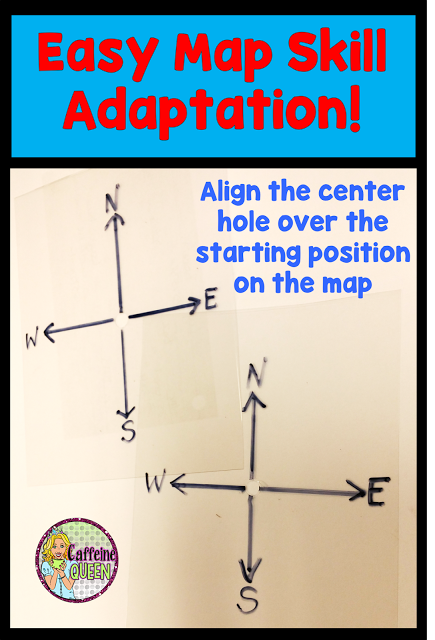
The simple fix: a transparent compass rose overlay
This is one of those teacher tricks that feels almost too easy… but it works.
You’re going to make your struggling students a transparent compass rose they can lay right over a map.
When they can physically line up the directions on top of the map, it suddenly clicks.
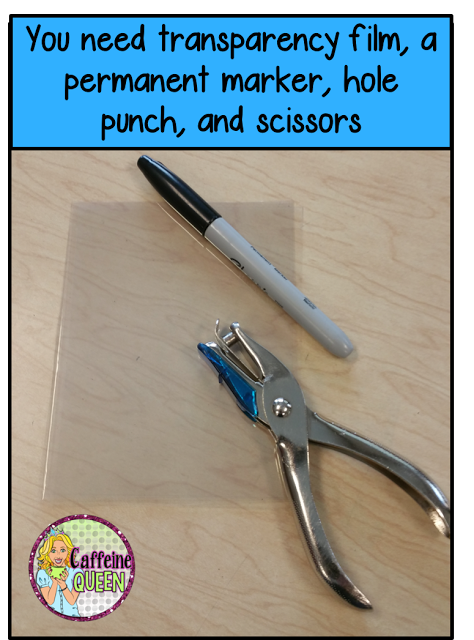
What you need
- transparency film (the kind teachers have hoarded for the last 20 years )
- permanent marker
- ruler
- hole punch
- scissors
That’s it.
How to make the overlay (quick + simple)
Step 1: Cut a square
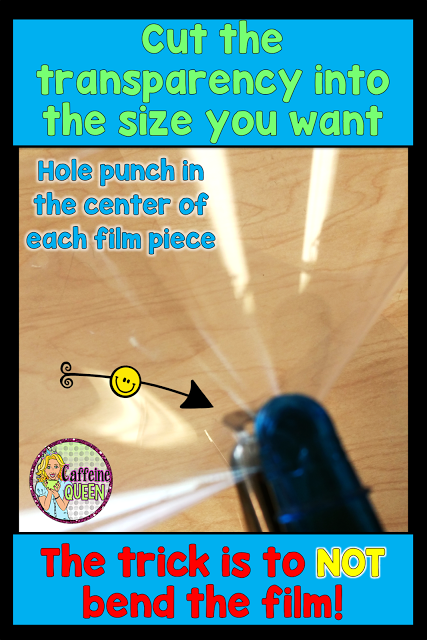
Cut a piece of transparency film into a square (or rectangle – no one is grading you).
Step 2: Find the center
Lightly bend the transparency into four equal parts.
Important: bend, don’t fold.
Folding leaves creases, and creases make everything annoying.
If bending isn’t working for you, just use a ruler to measure instead.
Step 3: Hole punch the center
This is the hardest part – not going to lie.
The trick is to bend it just enough to punch without leaving a permanent crease. Once you get that center hole, you’re golden.
Step 4: Draw your compass lines
Use a ruler + permanent marker to draw lines from the center point.
Then label:
N, E, S, W (cardinal directions)
and/or NE, SE, SW, NW (intermediate directions)
Differentiate in 10 seconds
This is where the overlay becomes magic.
You can easily adjust the support level:
- Support level 1: label only cardinal directions
- Support level 2: add intermediate directions
- Support level 3: draw the lines and arrows, but don’t label them (students label them)
- Support level 4: draw only the center point and let students build the compass rose themselves
If you don’t label the overlay, students still have to understand how directions work to answer correctly, so it supports students without giving away the thinking.
Why this helps struggling students
It removes the abstract “imagine the directions floating over the map” problem.
Instead, students can:
- line it up
- orient it
- visually track the direction from point A to point B
And then the answer becomes clear.
Ohio → Texas?
They can actually see it.
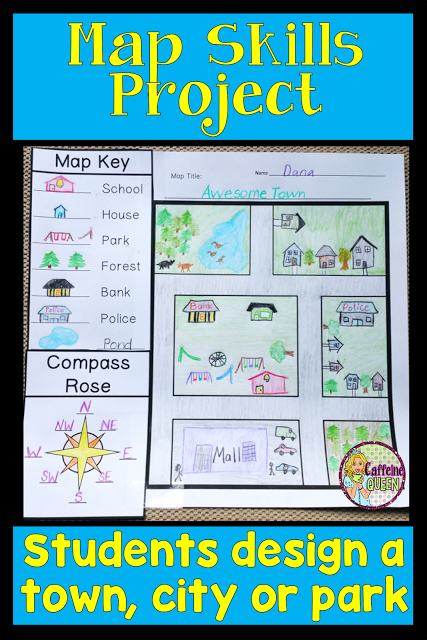
Ready to Print Map Skills Project
If you need a map skills project to practice more skills, I have one in my Teachers Pay Teachers shop that pairs perfectly with this strategy.
Students will create their own maps using this fun, creative activity to learn about reading maps. Students will love designing maps with towns, cities, parks, and islands. This complete set comes with practice worksheets and ready-to-print maps. It’s a project-based learning activity that’s a hands-on way to interact with maps.
About the Author
Written by Jules Rhee, MEd, and a 30-year teaching veteran; published 3/13/2017; latest update 3/2/2026
Jules is the creator of Caffeine Queen Teacher (CQT) – Visual Math Organizers + Graph Paper Support. She’s a veteran teacher with over 30 years of classroom experience (SPED, upper elementary, and middle school) and a Master’s in Education (MEd). Jules shares practical, classroom-tested ideas and creates step-by-step resources that help students stay organized, confident, and successful – especially with multiplication and long division.
Read more about Jules here: About Page | Browse resources here: TpT Store