





By Jules Rhee 8/7/2026
If you’ve used either the RACE or RACES writing strategy with your students, you already know there isn’t a huge difference between the two. RACES simply adds one more step.
But that one little S can raise a bigger question for teachers:

Do students really need it right away?
For me, the answer was usually no.
Especially at the beginning of the school year, I preferred starting with RACE.
Once students understood how to restate the question, answer it, find text evidence, and explain their thinking, then we could talk about adding a summary sentence.
There was no prize for getting all five letters onto the paper in September.
I wanted students to understand what they needed to include in their responses and how to include it.
So at the beginning of the year, four steps were plenty.
I found this out the hard way one year. My students told me they’d already used RACES before, so I handed out a passage and the RACES organizer, feeling pretty good about how it would go.
Well… it didn’t go how I planned.
What came back was mostly just answers. A little restating here and there, evidence added in without much thought, and almost no explaining at all. They knew what the letters stood for, they just hadn’t learned what to do with them.
So we went back to RACE and started from the beginning. We reviewed and practiced those first four steps over and over before I ever brought up the S again.
RACE vs. RACES: The Difference Between the Two Writing Strategies
If you need the full explanation of each step, I go into much more detail in my How to Teach the RACE Writing Strategy blog article.
But here’s a quick refresher.
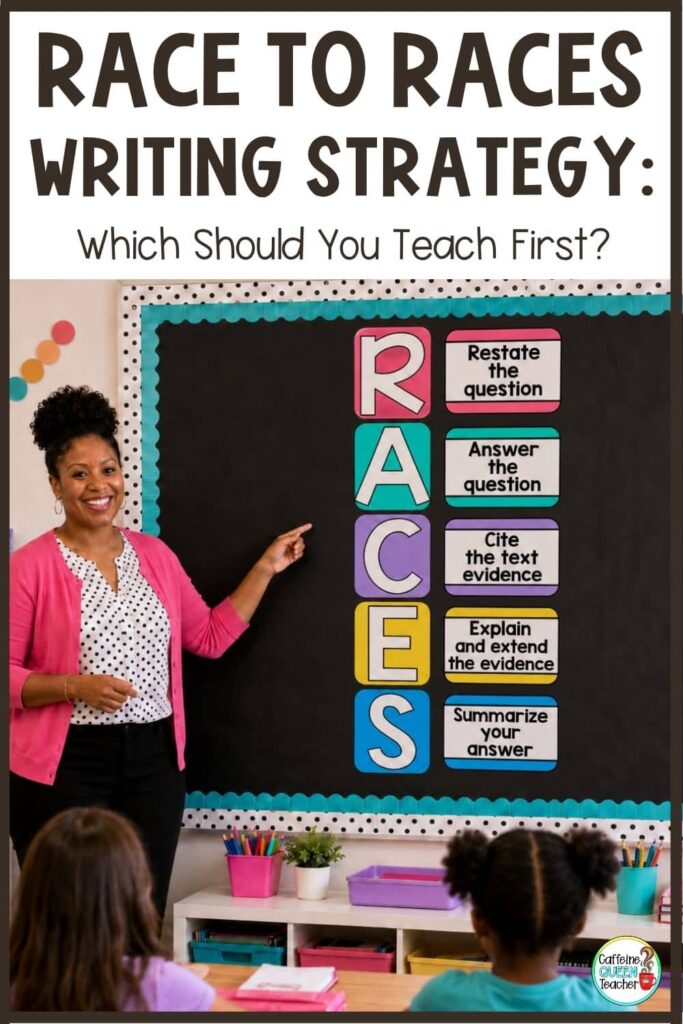
RACE stands for:
- Restate the question
- Answer the question
- Cite text evidence
- Explain and extend your thinking
RACES adds:
- Summarize your answer
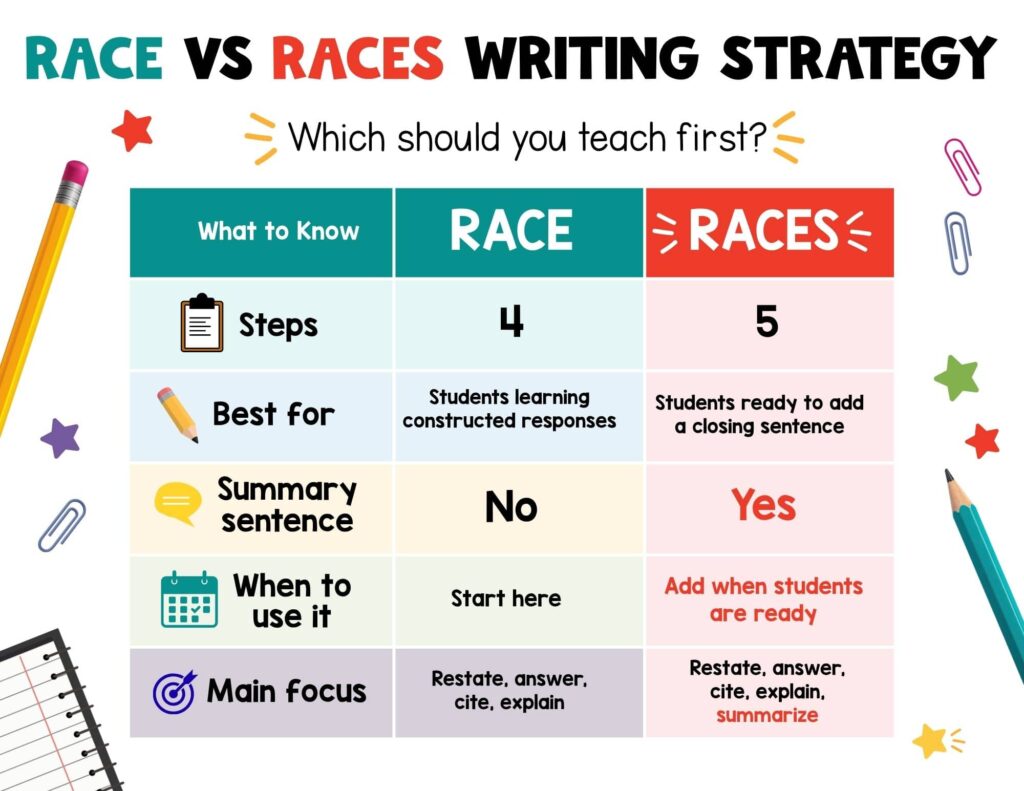
So, when teachers ask me whether they should use RACE or RACES, I don’t really think of it as choosing one strategy over the other.
I think of RACES as a natural extension of RACE.
Students learn the important work first. Then, when they’re ready, you add the closing sentence.
Why I Like Starting With RACE
Think about everything students are learning at the beginning of a school year.
They’re figuring out your routines. They’re getting used to new classmates. They’re learning where materials go, how you want papers turned in, what your expectations are during reading and writing, and about a hundred other little things.
Then we hand them a reading passage and say, “Now write a complete constructed response.”
For some students, even figuring out how to begin that response is hard.
That’s where RACE is so helpful.
Instead of looking at a blank page and wondering what in the world to write, students have a place to start.
Restate. Answer. Find your evidence. Explain it.
I spent a lot of time modeling those steps.
I’d put the passage on the Smartboard and work through the question with the class. We’d talk about what the question was actually asking before anyone started writing. Then I’d model how I might turn the question into the beginning of my answer.
When it was time to find evidence, we went right back into the passage.
And the Explain step? That usually needed plenty of attention.
Students can get very good at finding a sentence in the text and copying it into their response. Getting them to explain how that evidence supports their answer is another story.
That’s why I didn’t feel any need to rush to the S.
There was already plenty to teach.
RACE Is a Complete Response
This part is important because sometimes RACE is treated like the beginner version of RACES.
I don’t see it that way.
A student who restates the question, answers it clearly, supports that answer with text evidence, and explains the evidence has written a solid constructed response.
That student has done some real thinking.
A closing sentence can make the paragraph feel more finished, and students should certainly learn how to write one. But I wouldn’t add it just because there happens to be another version of the acronym with an S attached.
First, I wanted the first four steps to make sense. Those steps are the real “meat” of RACE/RACES responses.
So When Should You Add the S?
I wouldn’t circle a date on the calendar.
Watch your students instead.
- Are they beginning their responses without waiting for you to walk them through every sentence?
- Do they go back into the passage and find evidence that actually supports their answer?
- Are they explaining the evidence instead of just dropping a quote into the paragraph and moving on?
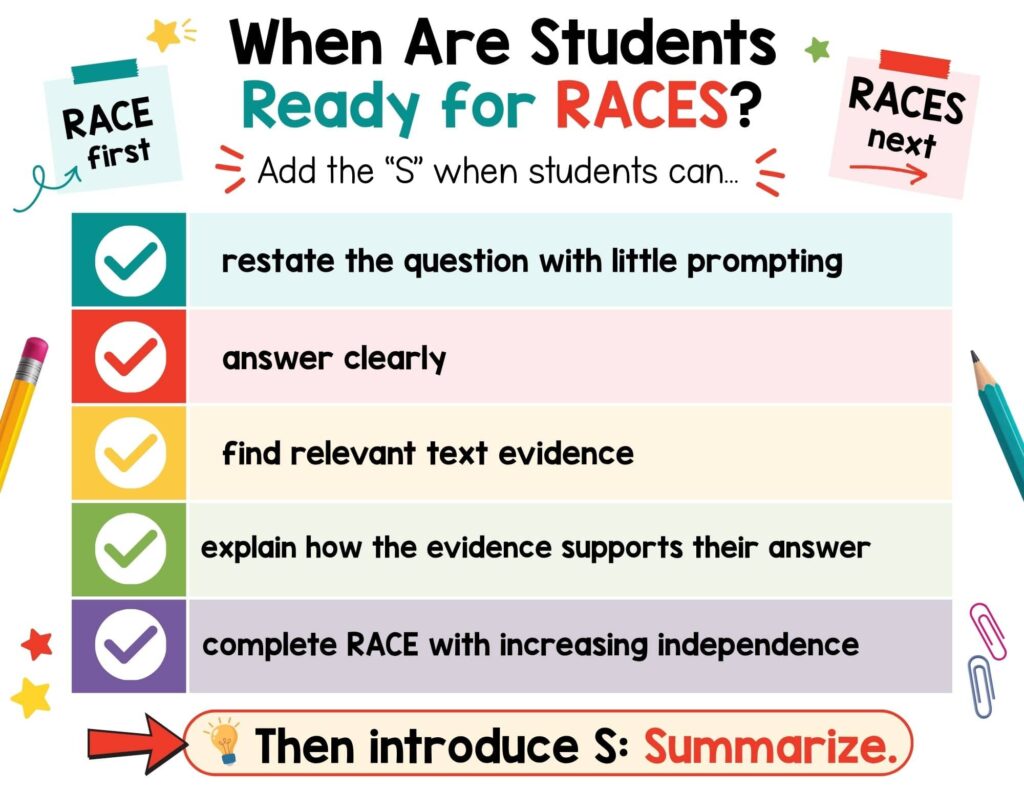
Those were the things I paid attention to.
When students could handle the RACE steps with less help from me, I knew I could introduce the S without turning the whole strategy upside down.
At that point, I’d explain that we were adding a way to wrap up the response.
Then I modeled it. Yes, again.
Even if students knew RACE well, summarize was still a new step. I didn’t just change the poster from RACE to RACES and expect everybody to know what to do.
We looked at examples together and wrote a few summary sentences as a class. We talked through what made an ending sound finished, and how that was better than just repeating the first sentence.
That extra practice mattered a lot.
What Does the Summarize Step Actually Add?
A summary sentence gives the response a clear, strong ending.
That can be helpful, especially with longer written responses and as students move into upper elementary grades.
But students need to see the difference between summarizing and repeating themselves to fully understand.
For example, if the first sentence says: The character showed courage when she entered the cave to rescue her brother.
We talk about why we wouldn’t want the final sentence to be: In conclusion, the character showed courage when she entered the cave to rescue her brother.
We haven’t really added anything there. We just added, “In conclusion.”
Instead, this is the time to show students how the last sentence can bring the answer back to the main idea: Her decision to enter the cave even though she was afraid shows how much courage she had.
It’s the same idea, but the ending sounds better because it isn’t repetition.
Students can learn to do that, but it takes a lot of practice, for sure. And it goes much better once they see and understand the difference.
That’s another reason I liked teaching the S separately, instead of piling it on while students were still trying to remember what the other letters stood for.
A Better Way to Think About Your RACE to RACES Timeline
Instead of choosing a date on the calendar to move from RACE to RACES, I’d slow it all down and think in terms of what students can actually do. By spending time reteaching and practicing, you’ll build a stronger foundation and make sure the steps truly stick this time.
Start by doing it together.
Use short passages and questions that don’t overwhelm students.
Model the entire process, and talk out loud about what you’re doing every step of the way.
When you’re restating the question, show students how you decide which words from the question should be used in the restatement.
Explain how to look back in the passage for evidence. Talk about which evidence to choose and how it directly relates to the question. Then, be sure to think out loud when you explain that evidence. I’ve found that putting the explanation in their own words is often the toughest part for students. Many kids just want to copy words from the passage and be done.
This is also the perfect time to give students a small visual reminder of the steps.
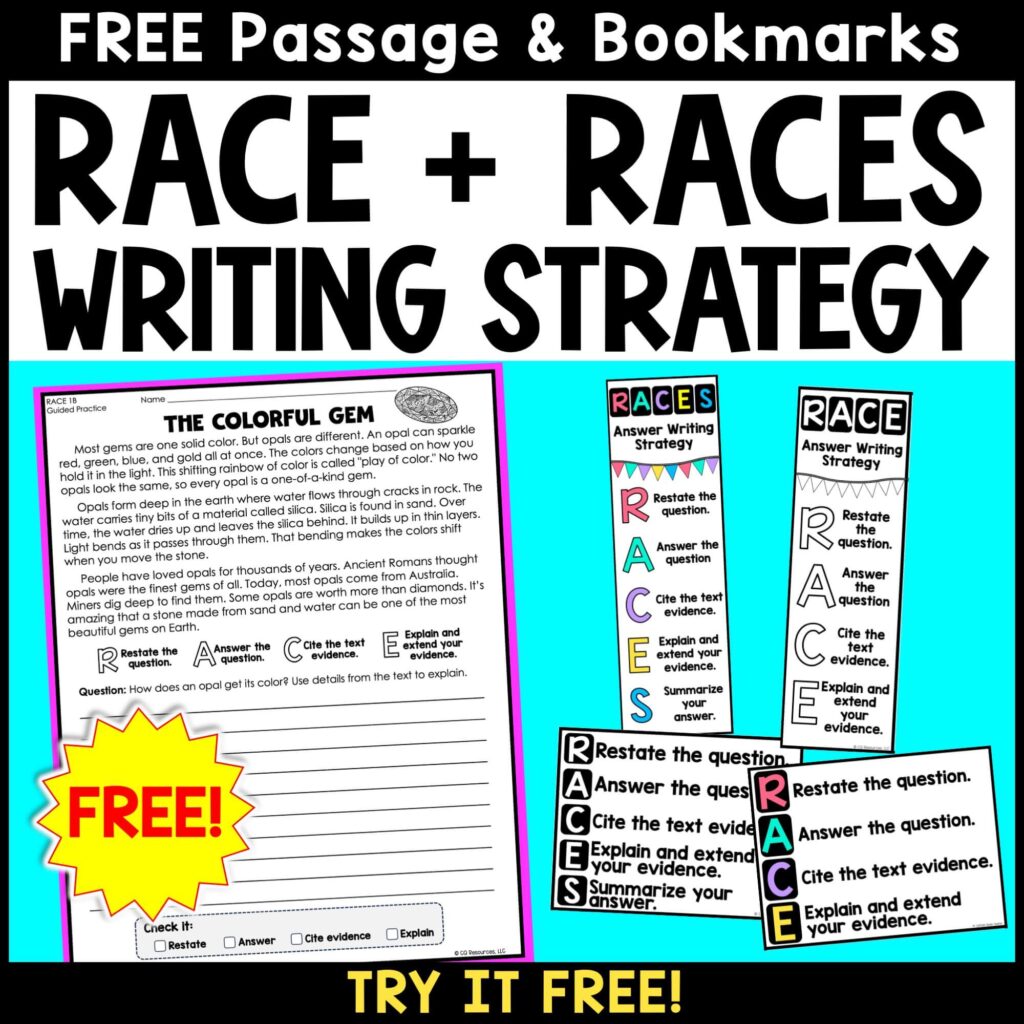
My free RACE and RACES passage & bookmark set has both versions, so students can keep the strategy right in front of them instead of constantly looking across the room at an anchor chart.
Then slowly hand over more of the work.
You might still model the question and restatement, but ask students to find their own evidence.
Or give them the evidence and have them work on explaining it.
I never felt like every student had to move through the strategy in exactly the same way or at exactly the same speed.
You can adjust the support level without changing the goal. It really is important to get the basics down before adding more steps to the process.
Introduce RACES when it’s time.
Once your students have a pretty good handle on RACE, show them how the summary step finishes the response.
Model several examples before writing some together as a class. Put a strong closing sentence next to a weak one, ask which one sounds better, and talk about why. A lot of kids need practice putting things in their own words. They need to understand there’s not just one right way to write it.
After that, let them try it on their own.
That progression makes much more sense to me than deciding ahead of time that every student should be using RACES by November 1.
In real life, learning doesn’t always fit neatly on our calendars the way we want it to.
Does Grade Level Matter?
Somewhat.
A third grader who is writing constructed responses for the first time may need much more practice with RACE before adding another step.
A fifth or sixth grader who has used RACE in previous years may be ready for RACES much sooner.
But I still wouldn’t decide based only on the grade level alone.
Take a look at their writing.
That will tell you much more.
If students are struggling to cite relevant evidence or explain what their evidence proves, adding a summary sentence probably isn’t the problem you need to solve first.
Work on the part that’s breaking down.
Then keep moving.
Can Some Students Use RACE While Others Use RACES?
Yes.
This is one of those things that can feel strange if you’re used to everyone in the class working from the same poster or organizer.
But students don’t all need exactly the same amount of support.
One student may be ready to write a complete RACES response independently.
Another may still need sentence starters for the Explain section.
Someone else may be perfectly capable of writing a strong RACE response but get completely tangled up trying to add a summary.
That’s useful information.
You can keep modeling the S with that student without throwing out the rest of the strategy.
If you use both versions in your classroom, though, be clear about what you’re doing.
If the poster says RACES and the paper says RACE, students are going to notice.
Explain why.
Something as simple as, “You already know these first four steps. Now I’m going to show you one more way to finish your answer,” makes the change feel much more manageable.
A Few RACE to RACES Mistakes to Avoid
Adding the S because you feel like you’re supposed to
If students are still struggling with the first four steps, stay there and keep plugging away at them.
There’s nothing wrong with spending more time on RACE. In fact, that’s the right move when they aren’t ready to add more to their load.
Letting students cite evidence without explaining it
This is a big one.
A copied sentence from the passage is not the same thing as an explanation. Students need practice connecting the evidence back to the answer. This is often the hardest step. It’s ok to spend more time on this step.
I would rather spend another week working on that than rush into summary sentences.
Assuming students already know how to summarize
A lot of students hear “write a conclusion” and simply rewrite the first sentence. I’ve even had students write In conclusion, that’s why.
Show them plenty of examples. Go over good examples and not-so-good ones. Put two endings side by side and ask which one sounds better.
Talk about why.
Those conversations often help much more than another worksheet.
Changing from RACE to RACES without talking about it
If you’re switching acronyms, tell students exactly what’s changing.
Four letters are familiar. One is new.
That’s much less intimidating than presenting RACES as an entirely different writing strategy.
RACE or RACES? Here’s Where I’d Start
If your students are new to constructed responses, I’d start with RACE.
If they already know how to restate, answer, cite, and explain without much support, introduce the S.
And if you start RACES and quickly realize students are getting stuck? Go back to RACE for a while.
That doesn’t mean the strategy or lessons failed. It means you’ve figured out what your class needs to work on next.
Fine-tuning your lessons to exactly what your students need is the art of teaching at its best.
RACE and RACES Practice
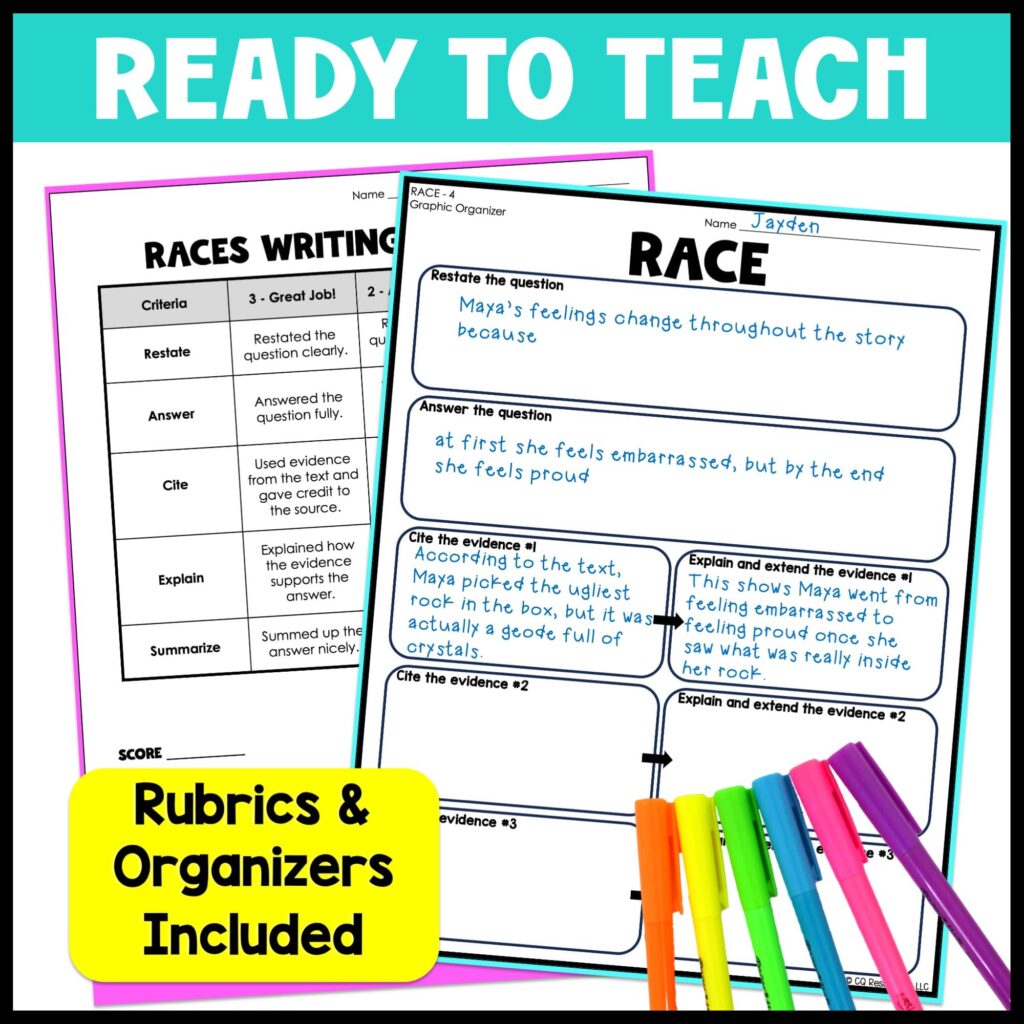
If you’re teaching this strategy and want everything in one place, my RACE and RACES Strategy Bundle includes passages, organizers, posters, rubrics, and sentence stems for both versions of the strategy.
That means you can start with RACE and move into RACES without having to replace everything you’re using.
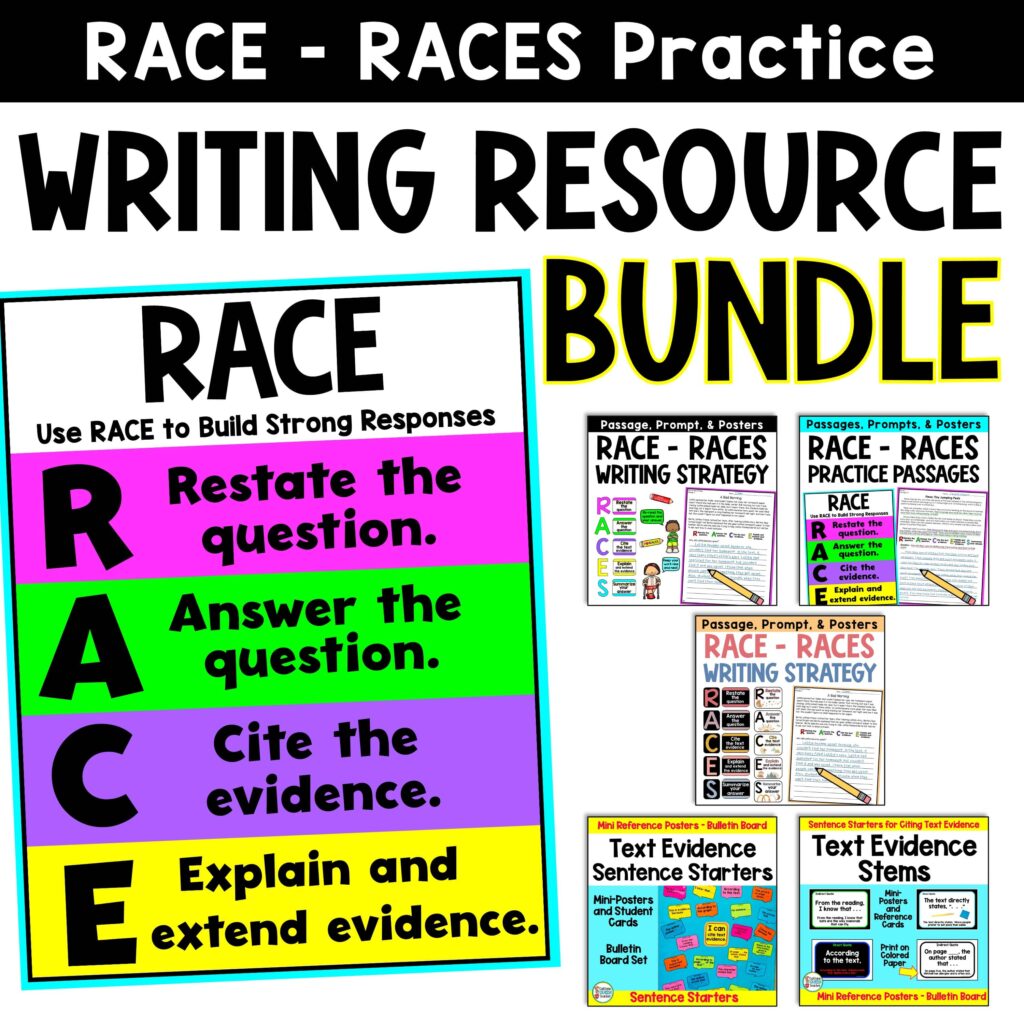
I also have separate reading comprehension passage sets if you need more practice:
RACES Reading Comprehension Passages for 3rd and 4th Grade
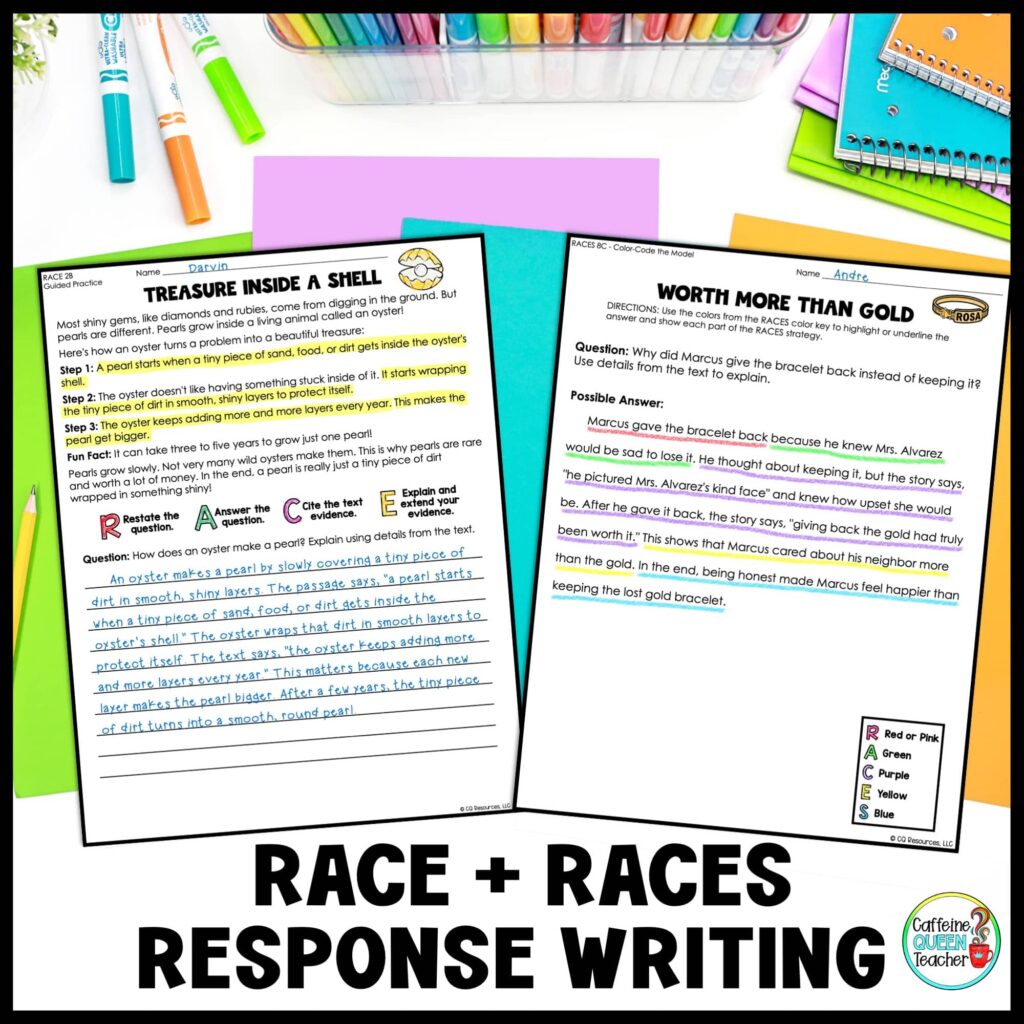
RACES Reading Comprehension Passages for 5th and 6th Grade: Treasures of Earth
And if you just want something simple students can keep beside them while they write, grab the FREE RACE and RACES passage and bookmark set.
Frequently Asked Questions About RACE vs. RACES
Is RACE or RACES better for elementary students?
I’d start most students with RACE, especially if constructed responses are new to them. Once they can use those four steps successfully, you can add the S for Summarize.
Do students have to use RACES?
No. RACE can produce a complete response on its own. Whether you add the S depends on your students, your writing expectations, and what you want them to be able to do.
What grade should start using RACES?
I wouldn’t choose based only on grade level. Some students will be ready earlier than others. Look at how well they can restate, answer, cite evidence, and explain before deciding whether to add the summary step.
Can I teach RACE and RACES in the same classroom?
Absolutely. You may use RACE earlier in the year and RACES later, or you may have students working with different levels of support at the same time. Just make sure students understand why they’re seeing two versions.
Keep Reading
New to the strategy?
Start with How to Teach the RACE Writing Strategy, where I break down each letter and share more tips for teaching constructed responses.
You might also find these helpful:
- How to Teach Students to Cite Text Evidence
- What Really Matters in a Strong RACE or RACES Response
- Free RACE and RACES Passage & Bookmark set
About the Author
Written by Jules Rhee, MEd, and a 30-year teaching veteran; published 8/7/2026.
Jules is the creator of Caffeine Queen Teacher (CQT) – Visual Math Organizers + Graph Paper Support. She’s a veteran teacher with over 30 years of classroom experience (SPED, upper elementary, and middle school) and a Master’s in Education (MEd). Jules shares practical, classroom-tested ideas and creates step-by-step resources that help students stay organized, confident, and successful – especially with multiplication and long division.
Read more about Jules here: About Page | Browse resources here: TpT Store