





By Jules Rhee | Published 1/3/2026
Struggling with long division with 2 digit divisors? This post explains why students get stuck and shares the key estimation step that helps kids choose quotient digits with confidence.
Why 2-digit divisors feel like a wall
- With 1-digit divisors, students can lean on facts and familiarity.
- With 2-digit divisors, they have to estimate while also doing the long division steps.
- If estimation isn’t clear, kids default to guessing, erasing, and more guessing.

What I want you to know: your students didn’t “forget everything.” This is a brain overload problem, not a motivation problem.
What’s actually overloading students’ brains
- Too many steps at once – divide, multiply, subtract, bring down… plus estimate
- Keeping numbers lined up while thinking hard
- Fear of getting the first digit wrong (because it messes up everything after)
What this looks like in real life (the “symptoms”)
When the load is too high, students don’t calmly “try strategies.” They do survival behaviors:
- Freeze at the top of the division symbol (bracket)
- Write any old number up there just to move on
- Pick a tiny “safe” digit (1 or 2), so it won’t be too big
- Erase a million times because nothing feels right
- Lose their place in the steps because they’re thinking so hard about the estimate
That’s not laziness. That’s overload.
What you can say to students: “This isn’t hard because you’re bad at math. It’s hard because your brain is doing more jobs at the same time.”

Why curriculum pacing makes it worse
A lot of curriculum programs act like estimation is something kids will just pick up along the way. So they move right into 2-digit divisors without slowing down to teach how to make a reasonable first try.
But many students do need estimation taught (or retaught) on purpose. When they have a simple routine, they stop guessing and writing random numbers in the quotient and start thinking, “Okay… what number actually makes sense here?”
And that’s when the pressure hits teachers, because you’re thinking:
“I taught the steps… why aren’t they getting it?”
“We’re supposed to be on Lesson 12, but half my class can’t even start.”
“If I slow down again, I’ll lose the kids who are ready.”
That pressure is real – and it’s exactly why this topic matters.

The routine that changes everything: Round – Predict – Check
This is the part I’d teach intentionally before you throw students into full problems.
Step 1: Round the divisor
- 24 → 20
- 18 → 20
- 47 → 50
Step 2: Predict using a friendly multiple
- “About how many 20s fit into 73?”
- 20 × 3 = 60 and 20 × 4 = 80
⮕ 3 is a smart first try
Step 3: Check by multiplying back
- 24 × 3 = 72
⮕ close and reasonable, so keep it - If it’s too high, drop by 1
- If it’s too low, go up by 1
What you can say to students: “We’re getting a smart first try – then we check.”
Guessing isn’t the enemy, but random guessing is
A guess with a plan builds number sense.
A random guess just builds frustration.
Language tweak that helps:
- Instead of “Guess the quotient,” say “Make a prediction.”
Teach estimation before starting to solve long division
This is the part that makes the rest go faster later.
Try 5-minute warm-ups like:
- “About how many groups?” (72 ÷ 18, 98 ÷ 21, 144 ÷ 36)
- “Which is closer?” (is 126 ÷ 29 closer to 3, 4, or 5?)
- “Check it fast” (students multiply back to see if it’s too high/too low)
⮕ When kids can predict and check without stress, the long division algorithm stops feeling so scary and heavy.
Are they ready for 2-digit divisors yet?
Ready signs:
- Can divide with 1-digit divisors fairly accurately
- Can round to tens (or at least talk about “about how much”)
- Can multiply 2-digit × 1-digit (even slowly)
Not ready signs:
- Counting facts every time
- Doesn’t understand what the quotient represents
- Alignment is so messy that the steps fall apart
If they’re not ready, that’s not failure. It just means they need more visual support and smaller steps first.
Common Trouble Spot + Quick Fix #1
Trouble: Students try to estimate using the whole divisor every time and freeze.
Fix: Teach “look at the front first” (the tens place), then multiply-back (check it by multiplying).
“Multiply-back” is the quick check where students multiply the divisor by their predicted quotient digit to see if it’s too high or too low.
Common Trouble Spot + Quick Fix #2
Trouble: Students pick “easy” quotient digits (1 or 2), so they won’t be wrong.
Fix: Make revising the first estimate feel normal.
- “If we estimate too high, we can drop by 1. If it’s too low, we go up by 1.”
⮕ That’s how math works. It’s ok to make changes.
A simple teaching flow you can follow
Day 1: Round + friendly multiples (no division brackets yet)
Day 2: Predict + multiply-back checks
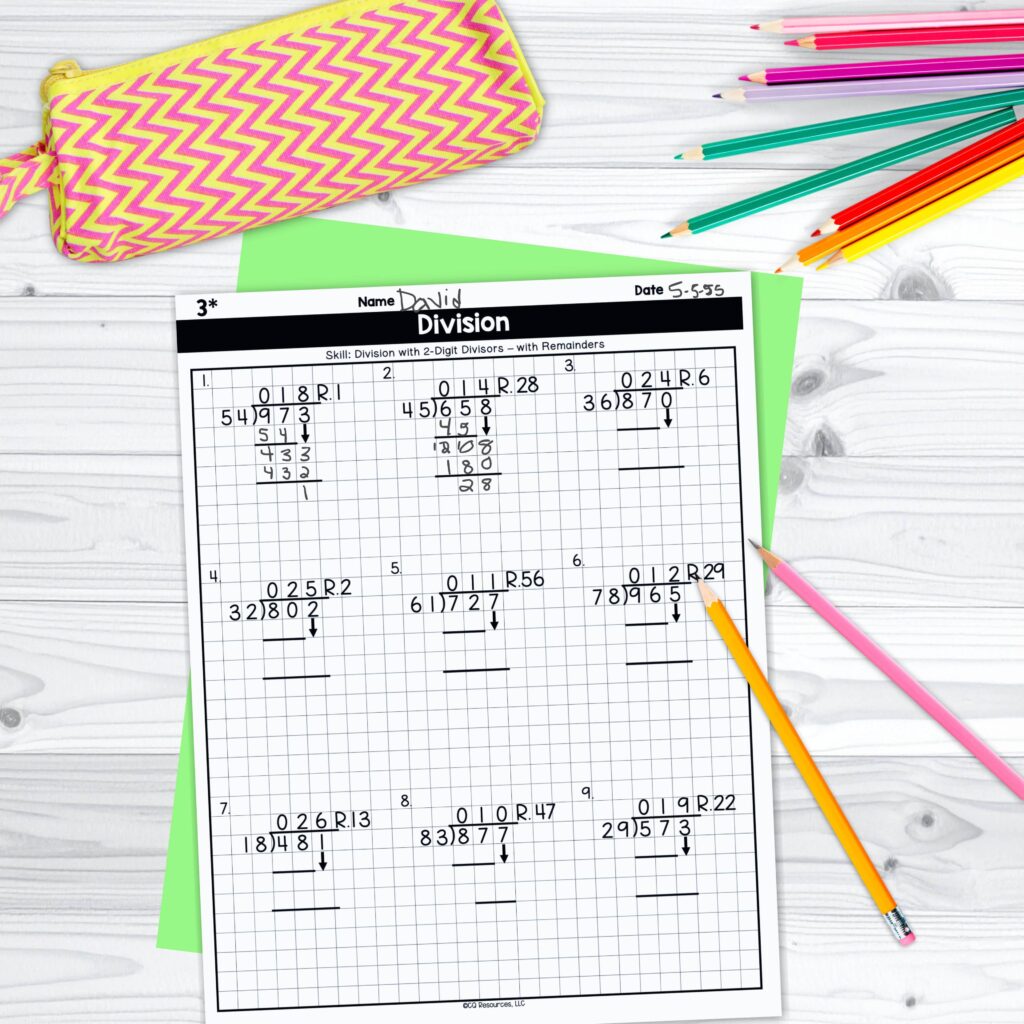
Day 3: Short division problems with support (grid paper or a division shape organizer)
Day 4+: Gradual release – guided, partner practice, then independent

Wrap it up with one tiny next step
If your students are stuck on 2-digit divisors, don’t reteach all of long division.
Teach the missing part – estimation with a routine – and the rest starts to feel possible again.
Next Steps

If you want a ready-to-use way to support this (especially for students who need visual structure), I use grid paper and step-by-step shape organizers to keep everything lined up and make the estimation step feel less stressful.
⮕ You can take a look here: 2-digit divisor long division resource

More articles you may like:
How to Teach Long Multiplication and Long Division
How to Solve Long Division Problems
9 Top Tips for Teaching Long Division
About the Author
Written by Jules Rhee, MEd, and a 30-year teaching veteran; published 1/3/2026.
Jules is the creator of Caffeine Queen Teacher (CQT) – Visual Math Organizers + Graph Paper Support. She’s a veteran teacher with over 30 years of classroom experience (SPED, upper elementary, and middle school) and a Master’s in Education (MEd). Jules shares practical, classroom-tested ideas and creates step-by-step resources that help students stay organized, confident, and successful – especially with multiplication and long division.
Read more about Jules here: About Page | Browse resources here: TpT Store