





By Jules Rhee 9/14/2026
I’ve had several questions from teachers and parents about RACE and RACES writing that usually sound something like this:
“Is it ok to combine Restate and Answer in one sentence?”
“Is this sentence Cite or Explain?”
“How do I know where Restate ends and Answer begins?”
And I get why people ask.

When we first teach RACE or RACES, we usually teach each part very clearly:
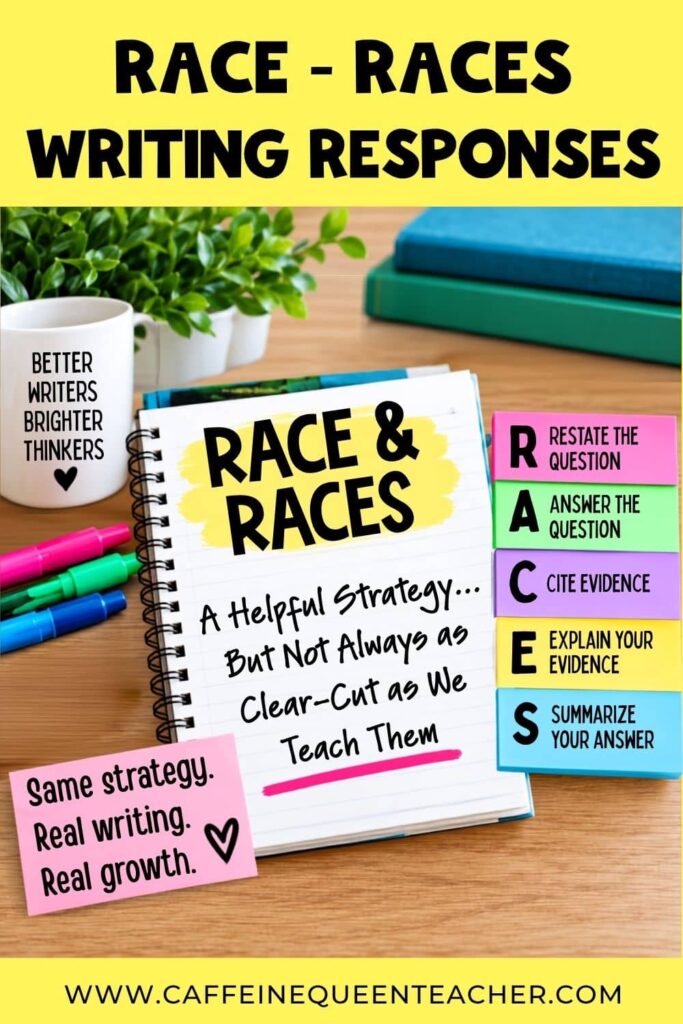
- R – Restate the question
- A – Answer the question
- C – Cite evidence
- E – Explain your evidence
- S – Summarize your answer
That structure is helpful, especially for students who have no idea where to begin with their written response.
But once students start writing longer, meatier responses, things don’t always stay quite that neat.
Sometimes Restate and Answer blend together.
Sometimes Cite and Explain overlap.
And sometimes you can stare at a sentence for way too long trying to decide which color to make it.
If you’ve done that, you’re not necessarily teaching RACE or RACES incorrectly.
The important thing is understanding what each part is supposed to do.
Should Restate and Answer Be Separate?
Not always.
For students who are just learning the strategy, it can help to think about the two steps separately.
For example:
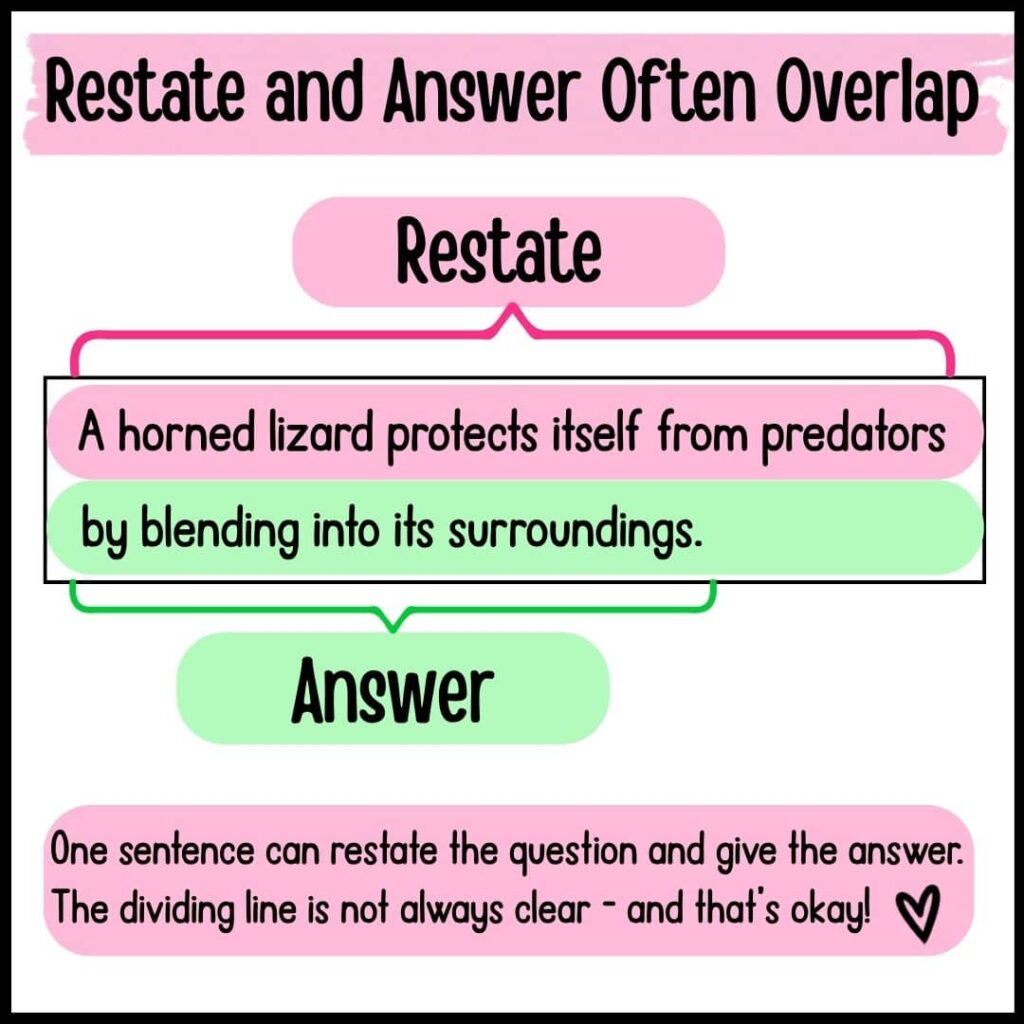
Question: How does a horned lizard protect itself from predators?
A beginning writer might first learn to restate the question:
A horned lizard protects itself from predators…
Then finish the thought with the answer:
…by blending into its surroundings and using other defenses.
Put those together, and you have:
A horned lizard protects itself from predators by blending into its surroundings and using other defenses.
So where does Restate end and Answer begin?
You could probably draw the line in a couple of different places.
And that’s the point.
The sentence is doing both jobs.
The student used enough of the question to give the reader context, and the student answered the question.
That’s what matters.
Restating the Question Is Still a Useful Skill
I don’t think teachers need to stop teaching the basic “turn the question into a statement” method.
For younger students, that little trick can be extremely helpful with getting their writing started.
Instead of them just answering the question with:
Camouflage.
Or starting with:
Because it blends in…
students learn to write a full sentence:
A horned lizard protects itself by using camouflage.
Now the response makes sense even if the reader hasn’t just read the question.
That’s a big step for a beginning writer.
As students get stronger, though, their opening sentences can (and should) become more natural.
Instead of:
A camel survives in the desert because…
a student might write:
Camels have several body features that help them survive harsh desert conditions.
Both can work.
The second one just sounds a little more like regular writing and a little less like the student is following a sentence frame.
That’s a progression we like to see.
What About Cite and Explain?
This is where things can get even trickier.
Students need to understand that citing evidence and explaining evidence aren’t the same thing.
Here’s a pretty clear example:
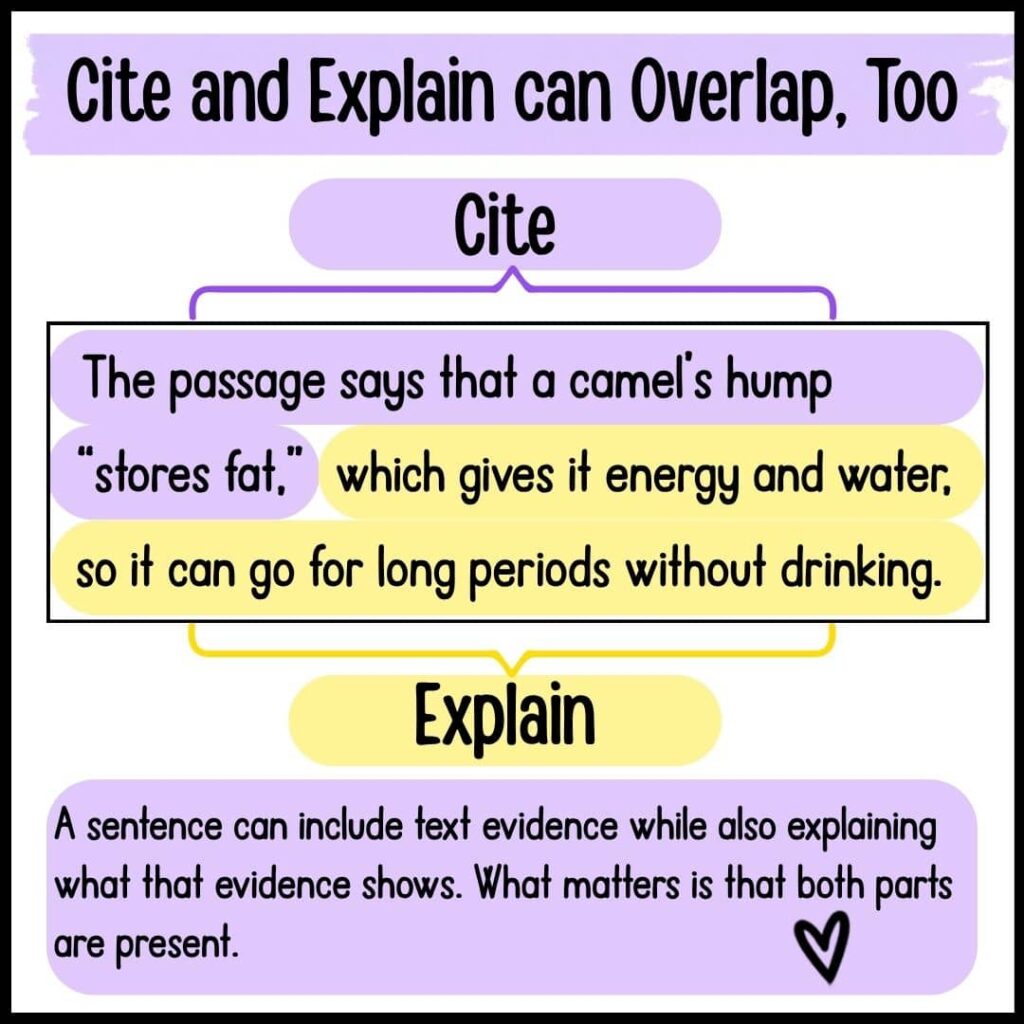
The passage says that a camel’s hump “stores fat.”
That’s evidence.
Then:
Its body can use that fat for energy and water, which helps the camel go for long periods without drinking.
Now the student is explaining why that detail matters.
Nice and clean.
But real student writing isn’t always that simple to categorize.
A student might write a sentence that includes information from the passage and also begins to explain what that information shows.
So then which way do we categorize it?
Is it Cite?
Is it Explain?
It’s actually doing both at the same time.
I wouldn’t spend too much time trying to force that sentence into one box. Instead, I would ask two questions:
Did the student include relevant evidence?
Did the student explain how that evidence supports the answer?
If both are there, the response is doing what it needs to do, even if it doesn’t fit into RACE/RACES neatly.
The Color Coding Can Get Messy
Color coding is useful when teaching RACE and RACES because it makes the different parts visible.
I used it for exactly that reason.
Students can look at a response and see where the writer answered, where the evidence came in, and where the explanation happened.
But sometimes the colors overlap.
That doesn’t automatically mean the response is poorly written.
Sometimes it means the writing is becoming more natural.
A sentence can serve more than one purpose.
That’s actually a good discussion to have with students.
You can ask:
“Would you call this Cite or Explain?”
Then let them defend their answer.
They may not all choose the same label.
That’s fine, as long as they can explain their thinking.
Does Every Letter Need Its Own Sentence?
No.
RACE and RACES are not meant to become:
Sentence 1 = R
Sentence 2 = A
Sentence 3 = C
Sentence 4 = E
Sentence 5 = S
That can be a helpful way to introduce the strategy, but students don’t need to stay there forever.
A strong response might have Restate and Answer together in the first sentence.
It might include evidence and explanation in the same sentence.
It might use two pieces of evidence with an explanation after each one.
There’s room for flexibility.
The goal is not to make every response look exactly the same.
So What Should We Be Looking For?
When we look at student responses, we should care more about whether the important thinking is there than whether we can perfectly label every sentence.
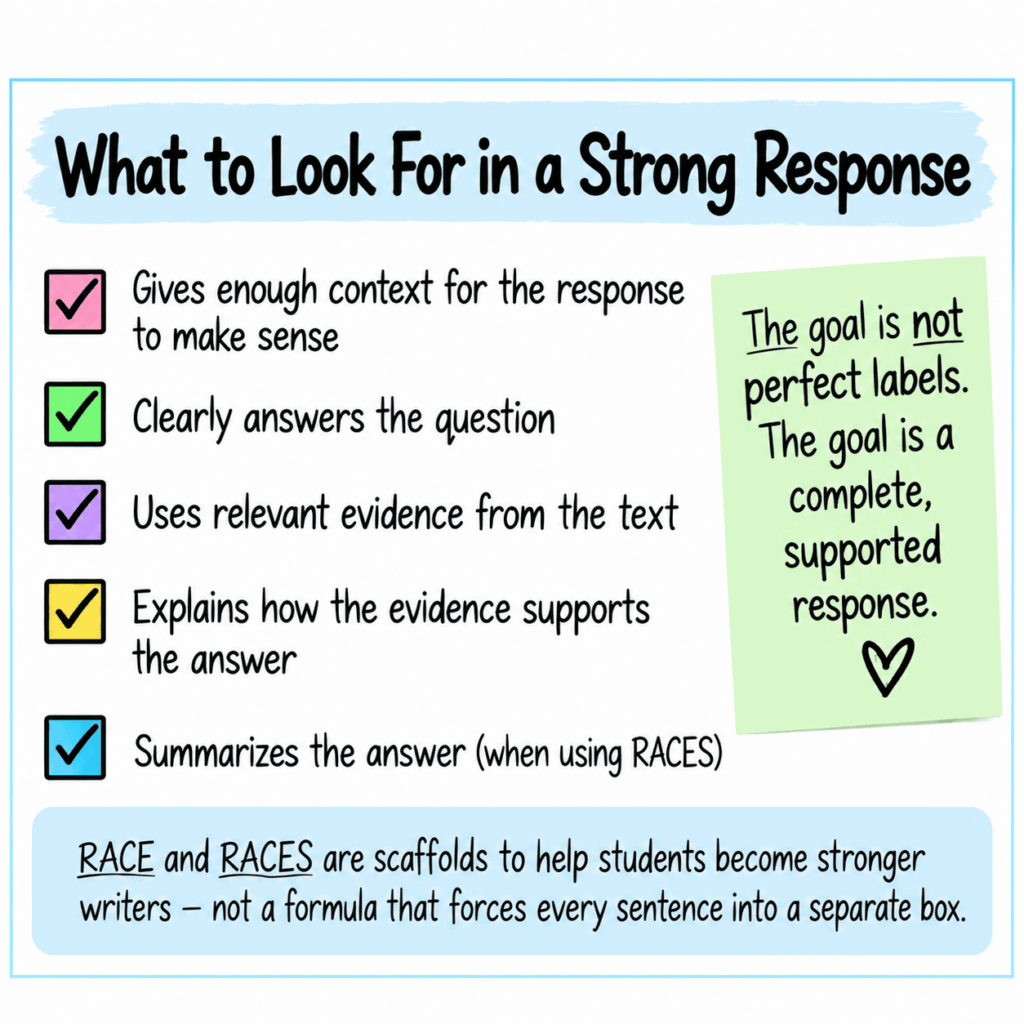
We want to see that the student:
- gives enough context for the response to make sense
- clearly answers the question
- uses relevant evidence from the text
- explains how that evidence supports the answer
- when using RACES, summarizes the answer at the end
If those parts are there, the strategy is doing its job.
RACE and RACES Are Scaffolds
This is probably the biggest thing I want teachers to remember.
RACE and RACES give students a starting point.
For some students, that structure is exactly what they need. Without it, they’ll write one sentence, copy half the passage, or jump into evidence with no explanation.
The letters give them a checklist in their heads.
But as students get stronger, some of those parts begin to blend together.
That’s not necessarily something we need to fix.
We don’t want students so focused on finding the exact “R sentence” or “E sentence” that they forget the bigger job:
Answer the question. Support it with evidence. Explain your thinking.
That’s where we’re trying to get them.
The RACE or RACES strategy is a guide to help them get there, not to box every sentence into a separate category.
Keep Reading
New to the strategy?
Start with How to Teach the RACE Writing Strategy, where I break down each letter and share more tips for teaching constructed responses.
You might also find these helpful:
- How to Teach Students to Cite Text Evidence
- Sentence Starters for Test Prep and Citing Evidence
- Free RACE and RACES Writing Set
About the Author
Written by Jules Rhee, MEd, and a 30-year teaching veteran; published 9/14/2026.
Jules is the creator of Caffeine Queen Teacher (CQT) – Visual Math Organizers + Graph Paper Support. She’s a veteran teacher with over 30 years of classroom experience (SPED, upper elementary, and middle school) and a Master’s in Education (MEd). Jules shares practical, classroom-tested ideas and creates step-by-step resources that help students stay organized, confident, and successful – especially with multiplication and long division.
Read more about Jules here: About Page | Browse resources here: TpT Store